Why make Nest Boxes out of Fibreglass (Glass Reinforced Plastic, GRP)
It is time, nay, well past time, that I describe the virtues of fibreglass for the manufacture of nest boxes for our beloved friends the birds. My first experience in fibreglass which was shared with an old and dear friend Robert Ward was in the making of our first surf board in Whitwell on the Isle of Wight. That was in April 1967 and just one month later we were repeating the exercise in Biarritz, south western France where our talents were required by a rather wealthy Frenchman. Subsequently I designed and built my own specialist inshore boat tested and approved by the US Navy Seals, the Danish SBS and the Malaysian Authorities. A story in itself for the future perhaps.
In 2003 I decided to develop some small nest boxes in fibreglass for certain bird species. The first was a Great Tit box, The second was a Robin box, The third was a larger Tawny Owl nest box. Many were installed on trees around my parents house, Springbank, in St Lawrence on the Island. Also many were installed around the neighbouring property, Maranatha (which incidentally was built by myself in 1977). I am pleased to report that everyone of them was successful and are still going strong. Until 2016 Joyce and I often stayed with our friend Tony at Maranatha taking the opportunity to install yet more boxes and examine the originals. Without realising it at the time I now know that St Lawrence was our original testing and proving ground for the feasibility of using fibreglass for the construction of LONG LIFE nest boxes.
Fast forward to 2015. I had married Joyce eight years earlier and we had moved to beautiful North Wales and settled in Brymbo. My step son Mark being one of the most generous human beings that you are likely to meet, casually said one day, "Grandad if you wish to use the old garage to make your nest boxes then go ahead and do so". Neither he nor I realised at the time what would be the result!!!! I had by this time realised and had the evidence that fibreglass was the ideal material to make nest boxes from, even though they would be very labour intensive. So the die was cast and the rest as they say is History.
Our small nest boxes are made of two layers of chopped strand fibreglass at 600 grams per meter squared, saturated in polyester resin and our larger Swift nest boxes are made with three layers. If you want to learn about the shear strength of fibreglass matrixes I recommend the book on the subject, Modern Boat building by the late Stephen Sleight. Essentially glass re enforced plastic has similarities with steel reinforced concrete insofar as the glass prevents the plastic from cracking in extremely cold weather. We are in a position whereby we get a lot of feed back about our nest boxes, some first hand and some second hand. One Swift expert advising a householder said, (about IMPECKABLE nest boxes) "they are a bit pricey but they are the best". This raises two questions, Why are they the best? and why are they pricey? For me a nest box has to last a long time to become a safe home for the birds to return to every springtime. It must not be decomposing year by year to jeopardise the well being of the fledglings. This is why wooden nest boxes are to be avoided by sensible bird lovers. Next we must consider the cost of installation which can exceed the cost of buying the nest box, especially for high installations for Swifts and Starlings which both love high nest sites. Then we have the problem of predation from the two main villains, namely Grey Squirrels and Greater Spotted Wood peckers. Both of these hungry predators can chew or peck their way through wooden nest boxes in very short order and eat the chicks inside. They CANNOT penetrate our fibreglass nest boxes. We know from so many private customers that the Swifts love our nest boxes. In the case of professionals I give you the example of the lead ornithologist on the Orcasitas project in Madrid, Luis Martinez, who said, "we love your Swift boxes". Then more recently he remarked that their research proves that the 350 Swift nest boxes that we have supplied have achieved over 50% take up.
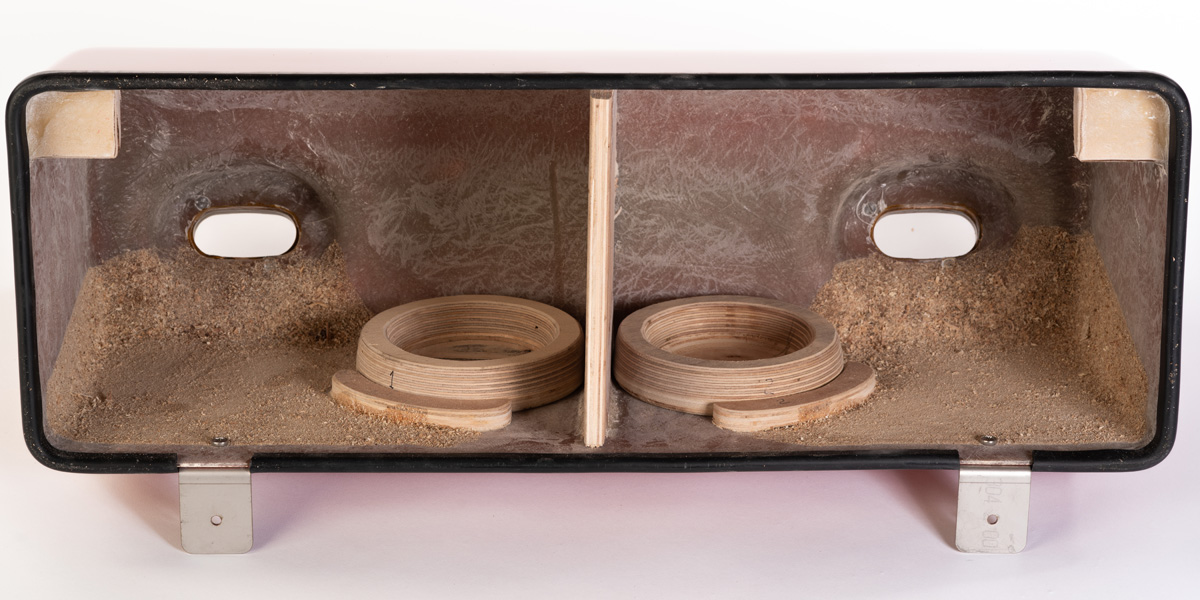
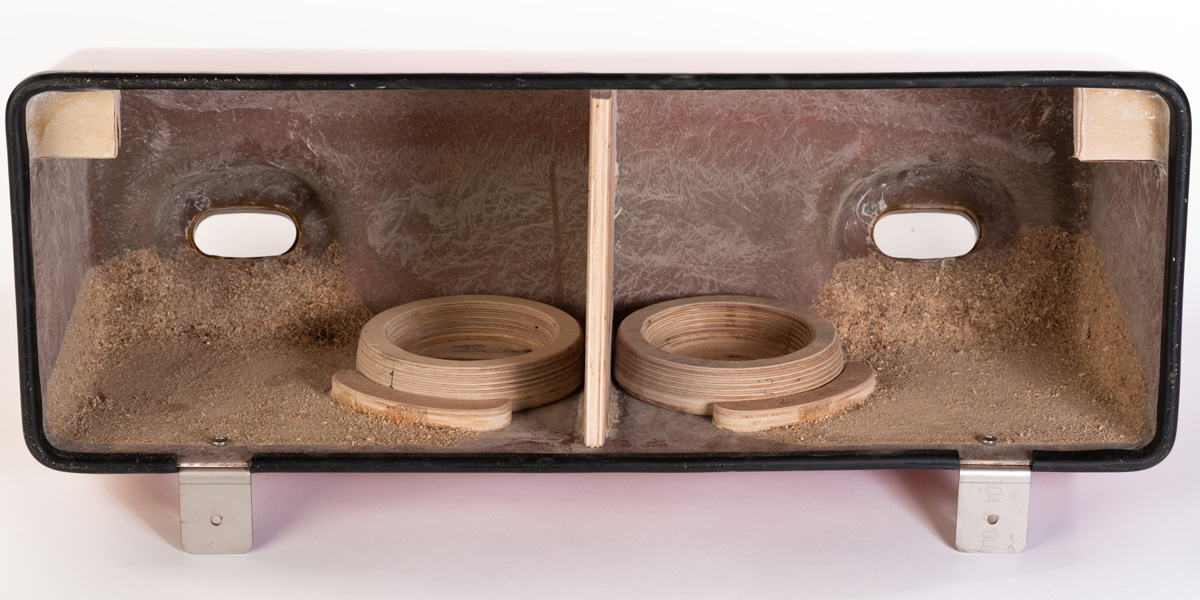
Now we analyse why they are (comparatively) pricey. It must be said that the cost of the materials are not in themselves our main contributor to the price. Moreover good house keeping and minimal wastage in our factory unit (which Mark supplied for us in 2019, cannot be blamed as a an expense. The cost of professional labour is where we must look. I will use the Swift Double Chamber Nest Box as an example. First it has to be wax polished (mould release agent) then when dry polished off. This process only takes ten minutes. Next we must mix up the gelcoat resin adding in the particular colour pigment specified by the customer and apply it with a brush. This job takes half an hour. We then have to laminated the three layers of fibreglass inside the mould once the gelcoat has gone off hard. This is the most time consuming process of the lot taking two hours. The following morning, when the new matrix has gone hard. the mould is taken down stairs to the finishing workshop. There are then several smaller jobs to be performed before the nest box is considered finished. First is ground out so that not one prickly part remains to injure the birds, then the partition and the hanging blocks are laminated in (total 40 minutes). Next day the new moulding (Swift box) is extracted from the mould and the edges ground to be perfectly straight and the outer surface polished. The entrance holes are then cut in and the outer wooden entrance holes screwed on. Bespoke wooden nest trays and steps are then glued into position and the sawdust floor resined in. These processes amount to one hour and ten minutes work. Finally, on the next day we super glue the rubber seal around the edge of the new Swift nest box and attach the stainless steel brackets which adds another 20 minutes work. Packing up is another 20 minutes. For anyone reasonable at maths once the sum total of our costs to produce our nest boxes is considered it will be APPRECIATED what quality costs and what real value for money IMPECKABLE nest boxes represent. We are very proud of what our hard work has achieved since 2015 in producing many thousands of permanent homes for the birds. Our contribution alone for the one species, the Swifts, means that the sad removal of their traditional nest sites has been significantly rectified by IMPECKABLE hard work and our customers funding. My heroes in the Swift movement Edward Mayer, Martin Garwood, Dick Newell and John Stimson are the inspiration for all of us. It is my hope and belief that a new generation will follow the example of my heroes, abandon their arm chairs and orange boxes and resort to action for the birds. Cats (10 million) and dogs (10 million) are not in danger of extinction in Great Britain but the birds are, so ACTION is needed. May I encourage all young people to make meaningful decisions to help the birds and avoid the media trap to waste yours lives on frivolity, as I did not do as a young man. It is never too late for action.
Len Haworth. December 15th 2025